
RuboCop Lazy Loads Cops Now
A mildly exciting performance refactor has landed in RuboCop v1.89.0: lazy-loaded cops! In short:
- RuboCop used to require all 600+ cops at startup,
- it now autoloads cops instead of requiring them,
- startup time has improved noticeably (10% up to 25%, depending on use case),
- plugin maintainers should migrate to the new API for everyone to benefit.
The rest of the post is this summary expanded with details.
Requires Just Kept Growing
Some context first. Early versions of RuboCop didn’t have many cops. For example, v0.3.0 (released in 2013) had only 31; departments didn’t even exist as a concept. Back then, it was fine to require all cops in lib/rubocop.rb.
But RuboCop kept growing. By v1.0.0, the number of cops exceeded 400. They were still required the same way; as a result, lib/rubocop.rb was pretty long.
Today, there are more than 600 cops. And with plugins included (e.g. rubocop-rails, rubocop-rspec, rubocop-performance, etc.), that number is even higher.
Requiring so many cops wouldn’t be an issue were we to actually use them all in each RuboCop run. But we don’t:
- most RuboCop configs enable only a subset of cops (e.g. Standard currently enables ~60% of all cops),
- you can run RuboCop with a single department (e.g.
bundle exec rubocop -xruns only Layout cops), - or even a single cop (e.g.
bundle exec rubocop --only Style/HashSlice).
Now a require in itself is not necessarily a slow operation, but hundreds of requires do add up:
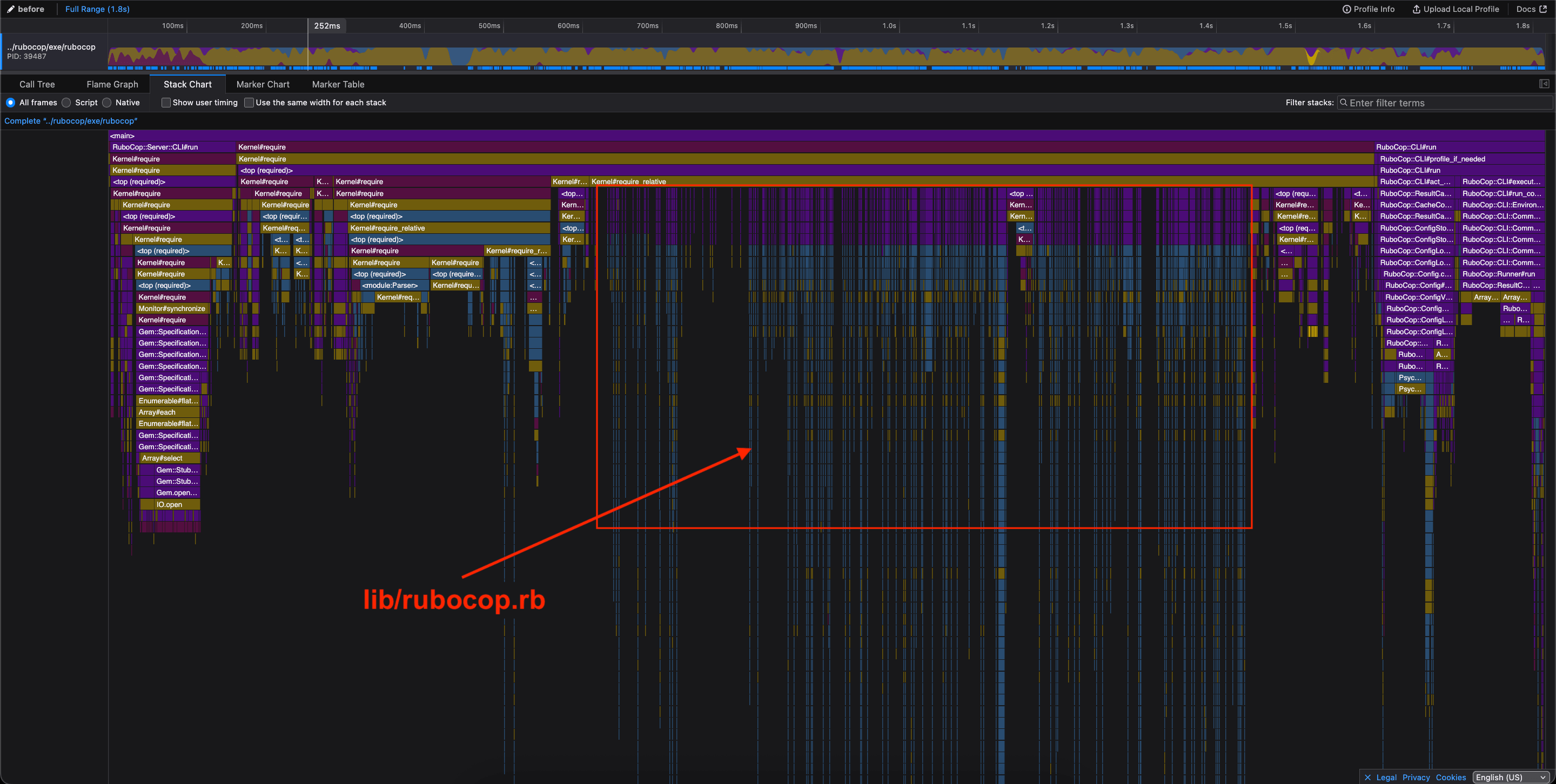
This is a performance profile (created with Vernier) of a RuboCop run with a single cop on just one file. The many “icicles” in the red box are all the cops being required. Even if you can’t understand this chart very well, it’s quite obvious that the highlighted part sticks out.
So, at this scale, requiring all cops at startup is wasteful. To optimize execution times, a natural solution is to load a cop file only when the cop is going to be used, i.e. load it lazily.
Some Technical Details
Ruby already has an API to lazy load a class/module: Kernel#autoload.
You might think that to lazy load cops, you just have to replace require with autoload. If it were that easy, this would be the shortest section in the post.
Here’s the thing. All cops inherit from the RuboCop::Cop::Base class, which defines a class method inherited:
# lib/rubocop/cop/base.rb
def self.inherited(subclass)
  # ... truncated ...
  Registry.global.enlist(subclass)
end
It’s a callback method “invoked whenever a subclass of the current class is created.” When you create your own cop class, this method will be called.
RuboCop::Cop::Registry is a class that saves references to cop classes. It’s used in various places in RuboCop, which I’ll get to in a bit. You create an instance of a registry and start adding cops to it (with #enlist).
Registry.global returns a global instance of the registry. You can, for example, call RuboCop::Cop::Registry.global.cops in the console to get a list of all cops.
So this callback adds a cop to the global registry whenever a cop class is created.
As was said, the registry is used in various places in RuboCop. Notably, Runner (which processes files for offenses) uses it to select cops to run based on .rubocop.yml and provided CLI options. If we don’t load cop classes, they won’t be added to the registry, and then Runner won’t work properly.
The lazy-loading initiative solved this problem in two steps:
Registryhas been refactored to support enlisting cops by stringified constant name. When the cop class is actually needed,Kernel.const_getis used to resolve the class.- A new method
register_cophas been added to the API. Itautoloads a cop class and adds the cop to theRegistryas a stringified constant name.
Here’s an example:
# lib/rubocop/cop/lint.rb
module RuboCop
  module Cop
    module Lint
      extend LazyLoader

      register_cop :AmbiguousAssignment, "#{__dir__}/lint/ambiguous_assignment"
      # other cops...
    end
  end
end
When lib/rubocop/cop/lint.rb is required, register_cop is called, which registers the cop Lint/AmbiguousAssignment under constant name "RuboCop::Cop::Lint::AmbiguousAssignment" in the global registry, and also autoloads the class (cop name and class name are the same).
Later, Runner accesses the cop from the registry, which calls Kernel.const_get to get the class, and autoload magic returns the AmbiguousAssignment class.
That is the gist of it. For in-depth details, please check out the PRs referenced in this issue.
Show Me the Numbers
Before the numbers, here’s the Vernier profile on lazy-loading RuboCop for the same scenario as above (single cop on just one file):
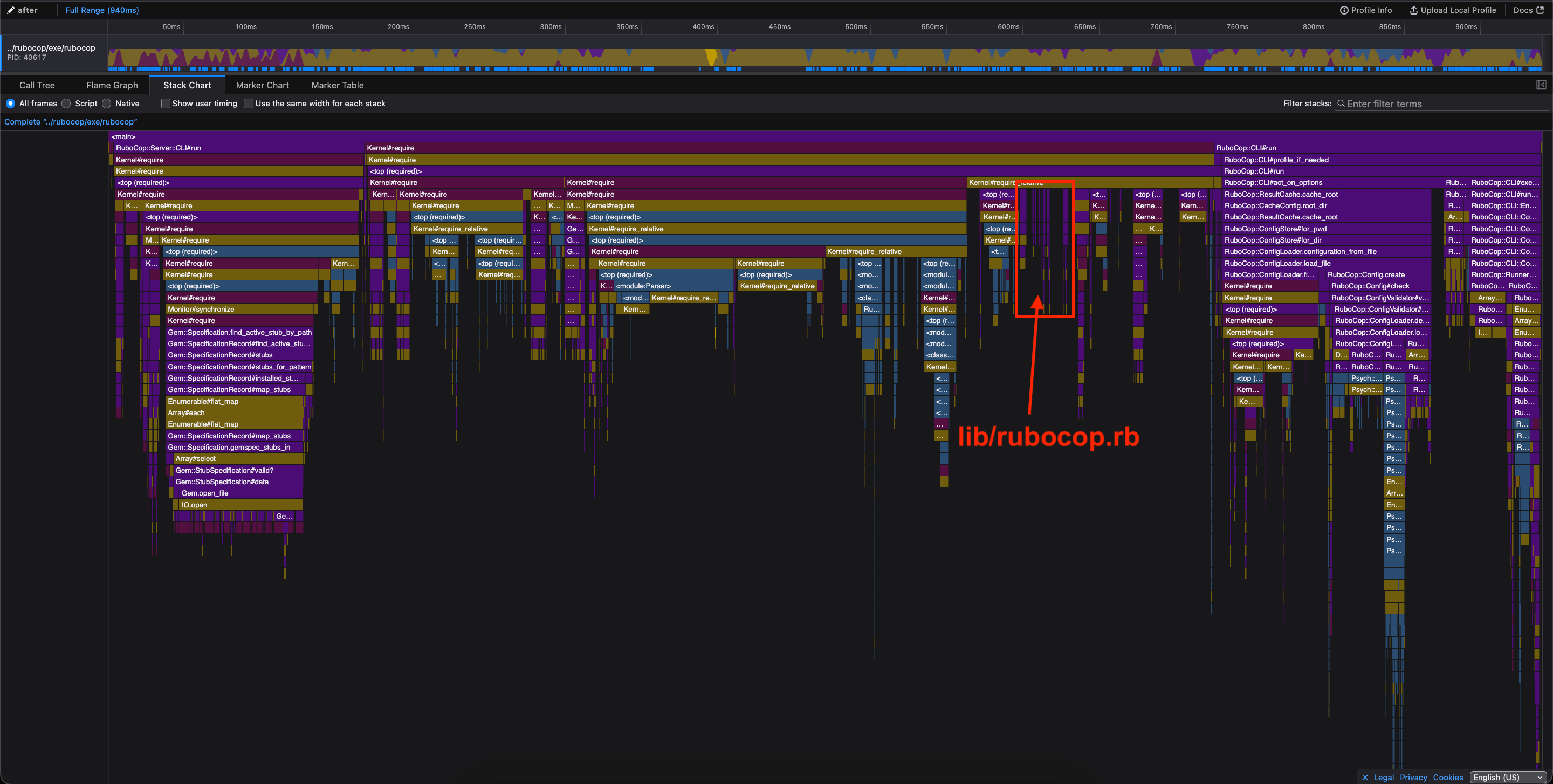
This is what we were aiming for, reducing the number of icicles.
Now for numbers. As was said above, speedup depends on the number of running cops. For simplicity, I’ve benchmarked all runs on a single Ruby file (multiple files naturally take longer) with caching disabled. All before and after runs have been repeated 30 times. Each run will display average execution time with standard deviation.
I’ll show you three RuboCop scenarios, in the order of most to fewest running cops:
rubocop(Standard config)rubocop --only [department]rubocop --only [cop]
After runs are on commit e9defb6 (when lazy-loading was added); before runs are on 8dc65e7 (the one before lazy-loading).
1. rubocop (Standard config)
For this setup, I configured RuboCop with Standard base config (353 enabled cops) and ran bundle exec rubocop --cache false.
Before: 1.650 ± 0.022 s
After: 1.473 ± 0.018 s
Execution time change: -10.73%
2. rubocop --only [department]
Similar setup to above (no Standard installed). I chose the Layout department. Around 100 cops ran.
Before: 1.578 ± 0.040 s
After: 1.280 ± 0.061 s
Execution time change: -18.88%
3. rubocop --only [cop]
Similar setup to above. I chose the Style/HashSlice cop.
Before: 1.554 ± 0.017 s
After: 1.138 ± 0.019 s
Execution time change: -26.77%
Interpretation
While the first before run is the slowest one, all before runs share similar execution times. This comes down to the fact that for a single file, most of the execution time is spent on startup rather than processing the file for offenses.
After runs have different times depending on the number of running cops. Fewer cops correlate with better times. The logical conclusion is that the best RuboCop times are achieved with all cops disabled.
Standard is a very popular config, so I would say that ~10% improvement in startup time is the realistic win of this initiative. But please note that for many processed files, the improvement won’t be as visible because the time spent processing files will overshadow startup times.
How To Migrate to the New API
Lazy-loading was only added to RuboCop itself, but plugins will still require cops unless they too migrate to the new API. RuboCop’s documentation has all the details on lazy-loading, so I’ll just briefly demonstrate how to migrate away from require.
Whereas before you’d have a file to require all cops:
# lib/rubocop.rb
require_relative 'rubocop/cop/bundler/duplicated_gem'
require_relative 'rubocop/cop/bundler/duplicated_group'
require_relative 'rubocop/cop/bundler/gem_comment'
require_relative 'rubocop/cop/bundler/gem_filename'
require_relative 'rubocop/cop/bundler/gem_version'
require_relative 'rubocop/cop/bundler/insecure_protocol_source'
require_relative 'rubocop/cop/bundler/ordered_gems'
You can now use the register_cop method to register the cops for lazy-loading in the department namespace:
# lib/rubocop/cop/bundler.rb
module RuboCop
  module Cop
    module Bundler
      extend LazyLoader

      register_cop :DuplicatedGem, "#{__dir__}/bundler/duplicated_gem"
      register_cop :DuplicatedGroup, "#{__dir__}/bundler/duplicated_group"
      register_cop :GemComment, "#{__dir__}/bundler/gem_comment"
      register_cop :GemFilename, "#{__dir__}/bundler/gem_filename"
      register_cop :GemVersion, "#{__dir__}/bundler/gem_version"
      register_cop :InsecureProtocolSource, "#{__dir__}/bundler/insecure_protocol_source"
      register_cop :OrderedGems, "#{__dir__}/bundler/ordered_gems"
    end
  end
end
That’s it, your plugin is now ready for lazy-loading.
Three things to note:
- set minimum RuboCop version to
1.89.0in the gemspec because of the new API - add
extend LazyLoaderto the module so you can useregister_cop - provide an absolute path to the cop file in the second
register_copargument (hence the use of__dir__)
Depending on your plugin, there might be some other details to take into consideration. As a practical example, take a look at this PR that added lazy-loading to rubocop-rails.
I encourage plugin authors to use the new API so we can all reap the benefits of faster RuboCop.
Thanks Department
I got inspiration for this initiative when I saw this issue by Jean Boussier that included an idea to lazy load cops. While he started in the right direction, his proof of concept probably got stuck when it came to dealing with the cop registry and other bits. Nevertheless, it inspired me to give it a try. Thanks Jean!
After the first couple of PRs were merged, Koic took over and did gargantuan work to finish everything. I’m super happy this happened because it sped up the most tedious part of the initiative. Thanks Koic!
Last but not least, thanks to RuboCop creator Bozhidar Batsov for being on board with the whole thing — it means a lot!
That’s all, thanks for reading!